“Your labs are normal.” “You’re just stressed.” “Try sleeping more.” “This is just part of getting older.”
If you’ve heard some version of that from a doctor while knowing in your gut that something is actually different, you’re not crazy and you’re not alone. I hear these stories constantly. Women in their late 30s and 40s who have been dealing with exhaustion, weight gain, brain fog, mood changes, and terrible sleep for months or even years, and nobody has checked their hormones. Perimenopause symptoms and treatment are not talked about nearly enough, and too many women spend years being told they’re fine when they’re clearly not.
So let’s talk about what’s actually happening, what to watch for, and what you can do about it.
What Is Perimenopause and When Does It Start?
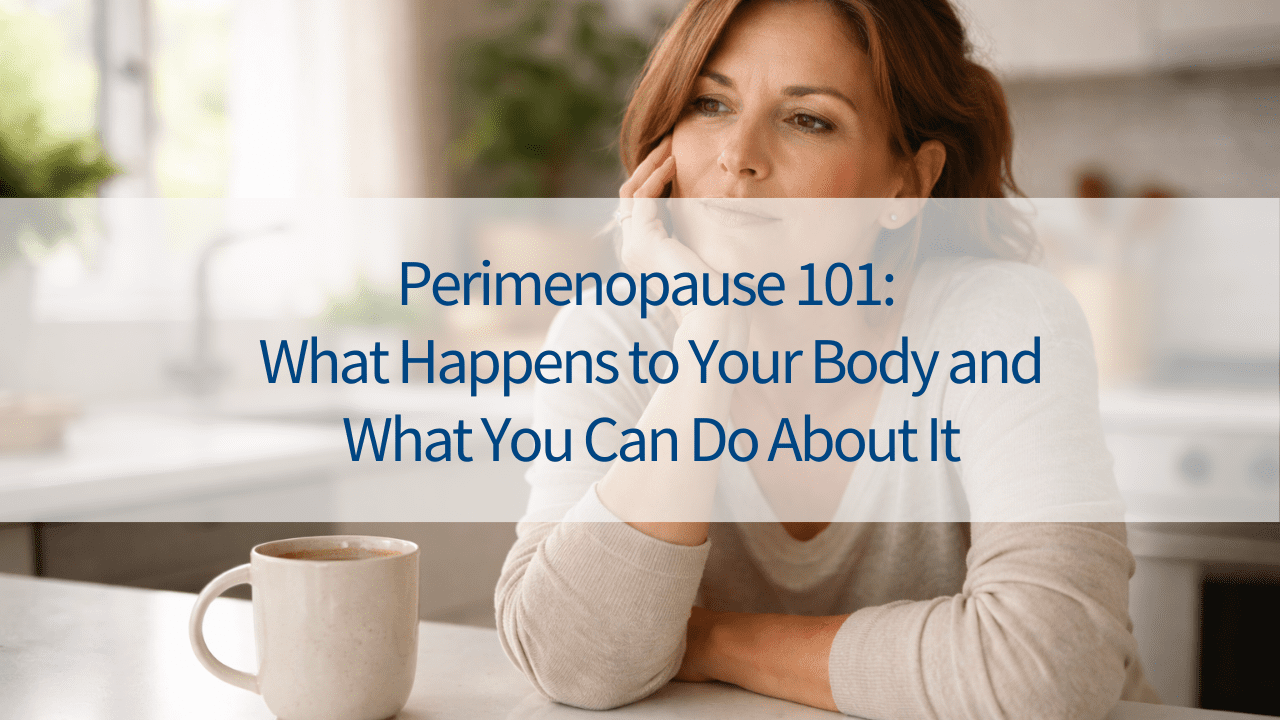
Perimenopause is the transition period leading up to menopause. It’s the years when your reproductive hormones, primarily estrogen and progesterone, start fluctuating and gradually declining. Menopause itself is defined as 12 consecutive months without a period. Perimenopause is everything that happens before that.
Most women associate menopause with their early 50s, and that’s roughly accurate for when periods stop. But perimenopause can start much earlier than most people realize. For some women it begins in their mid-40s. For others, the late 30s. I’ve had patients in their late 30s come in with textbook perimenopause symptoms who had no idea that’s what was happening because they assumed they were too young.
You’re not too young. If you’re in your late 30s or 40s and something feels different, it’s worth looking into. The average age range is broad, and there is no single timeline that applies to everyone.
What’s Happening to Your Hormones During Perimenopause
Here’s what makes perimenopause confusing: it’s not a straight line down. Your hormones don’t just decline steadily. They fluctuate. One month your estrogen might spike higher than it has in years. The next month it drops. Progesterone typically declines first and more consistently, which is part of why sleep disruption and anxiety are often among the earliest symptoms.
Testosterone also declines gradually through your 30s and 40s, which can affect energy, libido, motivation, and body composition. And thyroid function can shift during this time too, which is why we often check thyroid levels alongside reproductive hormones. The symptoms overlap more than most people realize.
The result of all this fluctuation is that you can feel completely different from one week to the next. That’s not in your head. That’s your hormones doing exactly what they do during this transition.
Common Perimenopause Symptoms You Might Not Recognize
Most women know about hot flashes. But perimenopause affects far more than your body temperature. I see patients with a wide range of symptoms, and what surprises most of them is how many different systems are involved.
Sleep and energy. Waking up at 2 or 3 a.m. and not being able to fall back asleep. Night sweats that disrupt your rest even when you don’t fully wake up. Daytime fatigue that doesn’t improve no matter how early you go to bed. This is one of the earliest and most disruptive symptoms, and it’s frequently misattributed to stress.
Weight and metabolism. Weight gain, particularly around the midsection, that seems to appear out of nowhere. Your body composition shifts even if the number on the scale doesn’t change dramatically. Losing weight becomes harder than it used to be, and the strategies that worked in your 30s stop working.
Mood and brain function. Anxiety that shows up out of nowhere, often without a clear trigger. Irritability that feels disproportionate to the situation. Brain fog: walking into a room and forgetting why, losing words mid-sentence, struggling to concentrate. These are hormone-driven changes, not signs of aging or cognitive decline.
Cycle changes. Periods that become irregular, heavier, lighter, closer together, or farther apart. This is often the first thing women notice, but not always. Some women experience significant hormonal symptoms while their periods are still relatively regular.
Other changes. Joint pain and stiffness, thinning hair, dry skin, heart palpitations, decreased libido, and vaginal dryness. These are all estrogen-related and tend to become more noticeable as the transition progresses. We discuss the libido piece specifically in our hormonal imbalance symptoms blog post.
“Am I Too Young for Perimenopause?” Why the Answer Is Probably No
This is one of the most common things I hear. A woman in her late 30s or early 40s comes in describing symptoms that point clearly to hormonal changes, but she dismisses the possibility because she thinks perimenopause doesn’t start until closer to 50.
Perimenopause can begin as early as the mid-30s, though the late 30s to mid-40s is more typical. The timeline varies widely based on genetics, health history, and individual biology. If your mother went through menopause early, you may too. But even without a family history of early menopause, hormonal shifts can start earlier than expected.
The important thing is not to wait until your symptoms become unbearable before looking into what’s happening. The earlier we identify hormonal changes, the earlier we can address them. And the research increasingly supports that earlier is better. A large study presented at the 2025 Menopause Society Annual Meeting analyzed over 120 million patient records and found that women who started estrogen therapy during perimenopause had roughly 60 percent lower odds of breast cancer, heart attack, and stroke compared to women who started after menopause or never used hormones. Women who waited until after menopause to start therapy saw less cardiovascular benefit and a small increase in stroke risk. The researchers called it an early but important signal that the timing of hormone therapy may be one of the most significant factors in long-term outcomes.
That doesn’t mean every woman in perimenopause needs to start hormone therapy immediately. But it does mean that if you’re having symptoms and wondering whether it’s too early to do something about it, the answer from the research is that earlier intervention may actually be the safest and most effective approach.
Perimenopause Treatment Options That Actually Work
This is the part I wish more women heard sooner: you don’t have to just push through this. Perimenopause is a medical transition, and there are effective treatments.
Bioidentical hormone replacement therapy (BHRT). This is the most direct way to address hormonal decline. We use bioidentical hormones that are structurally identical to what your body produces. Depending on what your labs show and what symptoms you’re dealing with, treatment might include creams, patches, oral progesterone, or a combination. Some patients eventually transition to bioidentical hormone pellet therapy, which provides steady, consistent hormone levels without daily dosing. But we start with what makes sense for your specific situation and adjust from there.
Comprehensive hormone panels. Before we treat anything, we need to know exactly what’s happening. That means running a full hormone panel: estradiol, progesterone, testosterone, DHEA-S, thyroid, and sometimes cortisol and insulin. A symptom checklist alone isn’t enough. We talked about this approach in our lab work blog post.
Weight management support. If hormonal weight gain is part of your picture, we can address that simultaneously. Some patients benefit from combining hormone therapy with a GLP-1 medication for weight loss. This is a comprehensive approach that treats the hormonal and metabolic sides together rather than addressing one and ignoring the other.
Lifestyle strategies. Strength training, adequate protein intake, quality sleep, and stress management all support your hormones during this transition. These are not replacements for medical treatment when treatment is needed, but they make a real difference alongside it.
How We Approach Perimenopause Treatment in Decatur, AL
At PrecisionMD, we don’t treat symptoms in isolation. When a patient comes in with sleep problems, weight gain, mood changes, and fatigue, we don’t send her to four different specialists. We run a comprehensive panel, look at the full picture, and build a treatment plan that addresses what’s actually driving the symptoms.
I’m board certified in obesity medicine, and our nurse practitioners hold advanced certificates in obesity medicine. We have experience treating the overlap between hormonal changes and weight, which is something many providers aren’t equipped to handle together. Learn more about our team on our about page. For current pricing, visit our pricing page.
Ready to Find Out What’s Going On?
If you’ve been feeling off and nobody can tell you why, it might be time to check your hormones. Schedule a consultation at our Decatur or Madison, Alabama office and let’s get the full picture.
Call us at 256-286-1888 or book online to get started.
Frequently Asked Questions About Perimenopause Symptoms and Treatment
At what age does perimenopause typically start?
Perimenopause most commonly begins in the mid-40s, but it can start as early as the late 30s. The timeline varies widely. If you’re experiencing symptoms, age alone shouldn’t be the reason you rule it out.
How do I know if it’s perimenopause or something else?
Many perimenopause symptoms overlap with thyroid issues, stress, and other conditions. That’s why we run comprehensive lab work rather than guessing based on symptoms alone. A full hormone panel alongside thyroid testing gives us a clear picture.
Is hormone therapy safe?
Bioidentical hormone therapy has a strong safety profile when prescribed and monitored by a trained physician. The research has evolved significantly since the early 2000s. We discuss the current evidence in detail during consultations and will cover it in a future blog post.
Can perimenopause cause weight gain even if I’m eating the same?
Yes. Declining estrogen and progesterone shift your metabolism and body composition, particularly around the midsection. This is one of the most frustrating symptoms patients describe, and it’s not something willpower or diet alone can fix when hormones are driving it.
How much does perimenopause treatment cost at PrecisionMD?
Our pricing is fully transparent. Visit our pricing page for current costs, or call us and we’ll walk through everything before you commit.